.png)

2026.04.21
Solvent-Based or Hot Melt Tape? Key Considerations for Your Packaging Needs
Share On
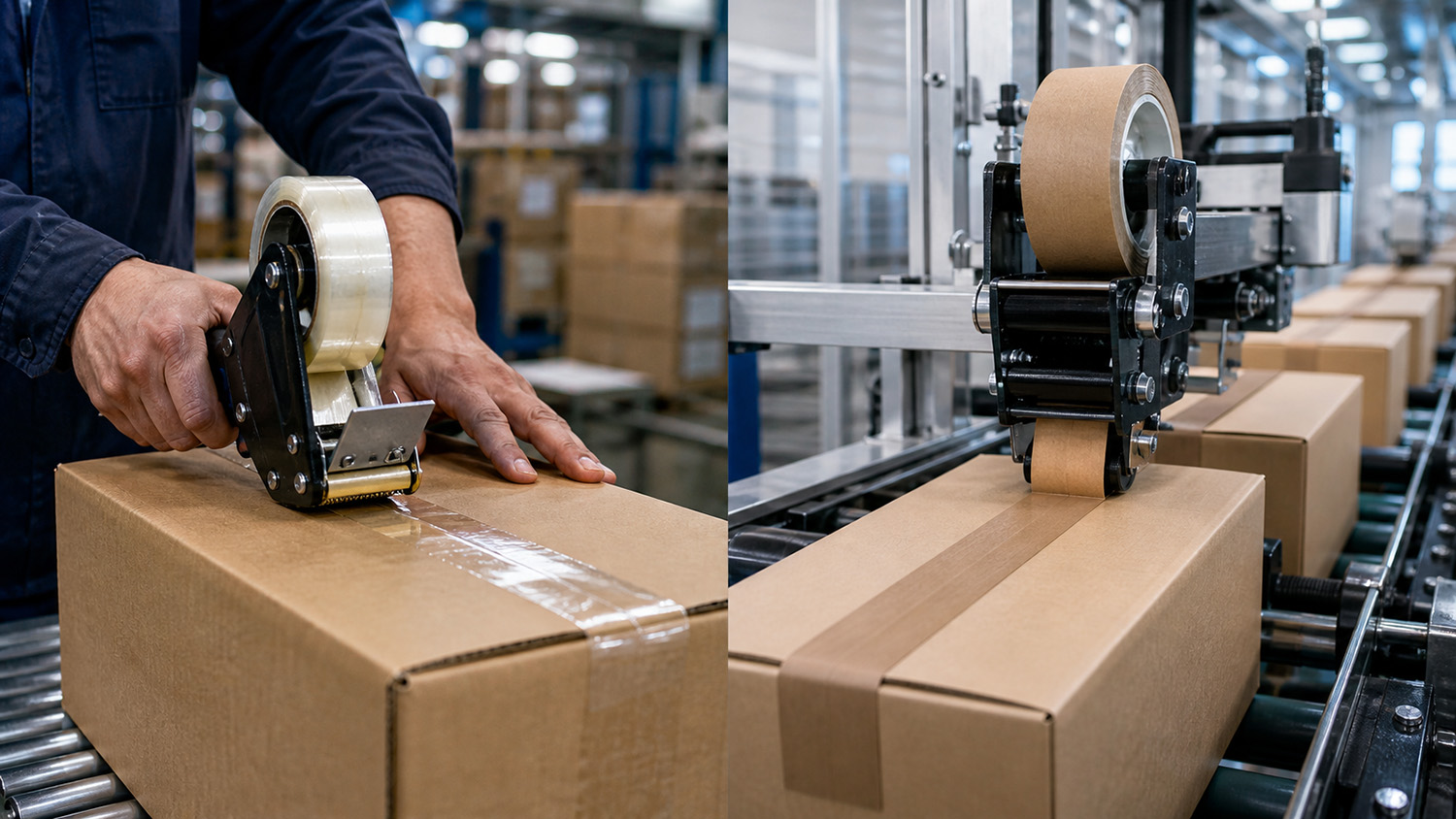
I. No "Best" Choice, Only the "Right" Choice
"Which tape is better?" is one of the most frequently asked questions in packaging material selection — and one of the hardest to answer with a single response. For logistics providers, e-commerce platforms, and manufacturers, the choice of tape involves shipping distance, warehouse temperature and humidity, level of automation, and even a brand's sustainability commitments. This article is not about recommending a specific product, but about providing a decision-making framework to help businesses find the option that truly fits their needs.
II. From Technology to Application: Real-World Performance
Solvent-based tapeis built around a solvent-based adhesive. As the solvent evaporates, the adhesive and crosslinker form a crosslinked structure, delivering exceptional long-term holding power and weather resistance.
It performs reliably on rough surfaces and printed or varnished box surfaces, even in high-humidity or temperature-variable warehouse environments. Formulations containing crosslinkers further enhance UV and solvent resistance, making solvent-based tape particularly well-suited for long-haul or ocean freight, heavy-duty cartons, and printed or varnished boxes where sealing stability is critical.Hot melt tapeis based on thermoplastic polymer adhesives that provide instant tack at room temperature, with very low volatile organic compound (VOC) emissions during production and a lower carbon footprint in the manufacturing process.
For facilities using automatic or semi-automatic case sealers, its fast-bonding characteristics match the pace of high-speed conveying lines, effectively reducing downtime and rework — with a real impact on overall production efficiency.Hot melt formulations offer high adhesion strength and have been modified to perform well on recycled corrugated board, which may contain mixed paper fibers and plastic components, providing reliable seal integrity. Thanks to the high elastic energy storage properties of synthetic rubber, hot melt tape is equally suitable for heavy-duty packaging, with cohesive strength sufficient to handle high-load sealing requirements.
On the sustainability side, hot melt tape on a kraft paper substrate achieves a 76% recyclability rate
and meets international recycling standards including EN 13430. Its biobased carbon content has been certified at 45% by TÜV Rheinland per ASTM D 6866, and it holds USDA Certified Biobased Product status — providing brands with directly citable documentation. Loop Tack test data also shows that hot melt tape outperforms comparable solvent-based tape in initial tack across the full temperature range from -10°C to 25°C, delivering more stable performance in cold chain or temperature-variable storage environments.| Comparison | Solvent-Based Tape | Hot Melt Tape |
|---|---|---|
| Adhesion | High, long-term holding power; crosslinker forms crosslinked structure | High, instant bonding; fast initial tack; high cohesive strength from synthetic rubber |
| Surface Compatibility | Wide, including rough and printed/varnished surfaces; advantage on uneven surfaces | Wide, including recycled corrugated board; modified formulation for high adhesion |
| Temperature Range | Wide temperature range; UV and solvent resistant | -10°C to 50°C; superior cold-temperature initial tack vs. solvent-based |
| Sustainability | Meets standard industrial packaging regulations | Low VOC, lower manufacturing carbon emissions; * biobased 45–47%, USDA certified, 76% recyclability (EN 13430) |
| Automation Fit | Usable; high-speed lines should evaluate unwind stability | Excellent; instant bonding matches high-speed line pace |
| Best Use Cases | Long-haul / ocean freight; heavy cartons; printed/varnished surfaces; weather-variable warehousing | E-commerce, FMCG, recycled cartons; heavy-duty packaging; case sealers; cold chain logistics; ESG procurement requirements |
| * Biobased 45–47%, USDA certification, and 76% recyclability data apply to kraft paper substrate products. | ||
III. Key Factors Before Making Your Choice
-
Packaging material characteristics come first.
Recycled corrugated board has uneven fiber surfaces and inconsistent moisture content — solvent-based tape's high initial tack and long-term holding power typically have the edge. For new corrugated board with uniform surfaces or standard e-commerce cartons, hot melt tape is more than sufficient. -
The shipping environment is equally critical.
Cross-regional shipping in North America and Europe can involve significant temperature swings. If goods are exposed to extreme cold or sustained humidity, prioritize verifying a tape's actual performance within the target temperature and humidity range — rather than relying solely on spec sheet numbers. Shipping duration also matters: the demands on holding power are fundamentally different for one-week domestic delivery versus transoceanic freight. -
Production line setup determines efficiency priorities.
High-speed automated case sealing lines require tape to establish a stable bond almost instantly — hot melt has a clear advantage here. For manual or semi-automated lines, the efficiency gap between the two narrows considerably. -
Corporate compliance goals are becoming harder to ignore.
Some retailers now explicitly require suppliers to meet recyclability or biobased content thresholds in their packaging specifications. Procurement teams that align early are often better positioned in negotiations. Within a Total Cost of Ownership (TCO) framework, unit material price is just one factor — damage rates, return and exchange costs, and equipment downtime losses all belong in the evaluation.
IV. Testing Beats Guessing Every Time
No matter how thorough the analysis, real-world variables are difficult to fully predict. Before making a full switch, we recommend a field test using 100 to 200 cartons over two to four weeks, covering the actual temperature and humidity conditions of the target shipping route and the real operating speed of your case sealing equipment. Evaluate seal adhesion performance, packaging efficiency, and in-transit open-box rates. The cost of testing is almost always far lower than the losses from a wrong material choice — this step should not be skipped.
V. Let Expertise Support Your Decision
The right fit is the best choice. Sometimes the optimal answer is not a single solution, but using both tape types across different product lines or shipping scenarios — each where it performs best.
Achem offers both solvent-based and hot melt product lines, along with technical consultation and sample testing support. Contact our team for an assessment tailored to your specific application.
📄 Get in touch: https://www.achem.com.tw/en/contact-form


1.png)
